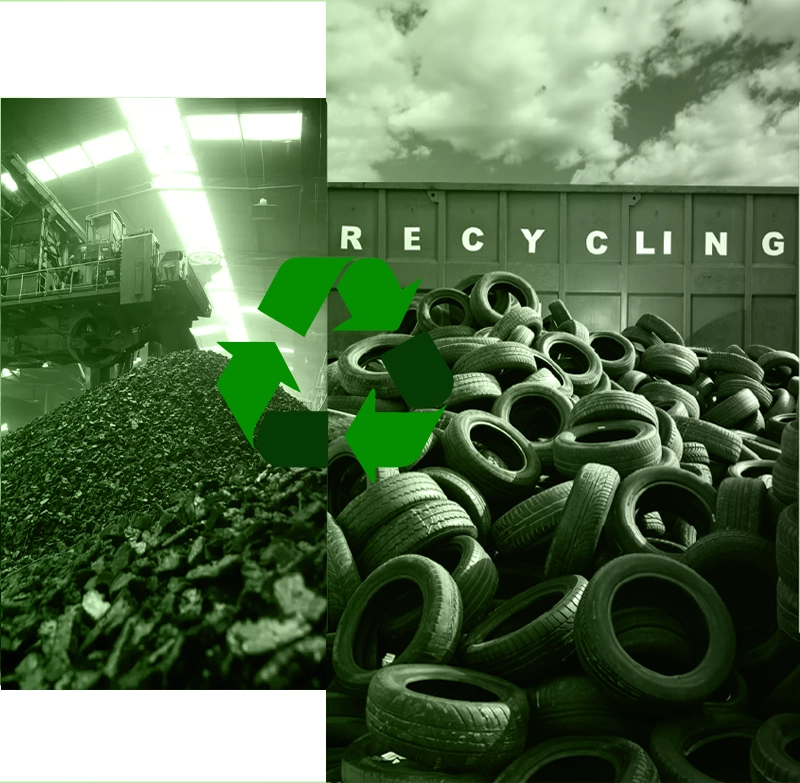
What “tire recycling and disposal” means in Florida
Once a tire comes off your vehicle for good, Florida stops treating it like trash. It’s regulated waste from that point on, which means it can’t ride out with the household garbage and it can’t sit in a pile behind a shop. It has to reach a permitted facility, where it’s recycled into something useful instead of buried.
That covers a lot of people. A homeowner with four old tires in the garage. A used-car lot clearing out a back lot. A repair shop generating a few dozen casings a week. A fleet manager with a yard full of them. Different volumes, same rules — and the same basic question: where do these go, and how do I do it right? That’s what the rest of this guide walks through.
We’ve put it in the order people actually ask. First the practical part: your options for getting tires off your hands, and what each one runs you. Then the legal side, since a lot of folks don’t realize tossing a tire is a fineable thing in this state. After that, what tires turn into once they leave, how it works for businesses that make tires by the load, and where in Central Florida we cover. Each section gives you the lay of the land, then points you to the full guide if you want the depth.
Your options: drop-off, pickup, and curbside
For a small batch, drop-off is the simplest route. You bring the tires to a permitted yard and pay a small per-tire fee. At our Apopka counter that’s $3 a tire for passenger and light-truck sizes — no minimum, no appointment, rims on or off, seven days a week. You hand them over, we count them, you’re done.
If you’ve got volume, scheduled pickup makes more sense. We run pickups for shops, dealers, and fleets across the area and usually get out the same week. Curbside is the option people reach for first, but it’s the most limited: city and county trash haulers cap how many tires they’ll take and how often, and many won’t take them at all without a special arrangement. Knowing the limits before you stack tires at the curb saves a wasted trip.
The fee question comes up every time, so here’s the short of it — for a passenger or light-truck tire at a counter like ours, you’re looking at a few dollars apiece, not the wild numbers some folks brace for. Where it gets bigger is volume and the odd sizes: trailer, ATV, and the large commercial or ag tires that need a heads-up call. The cost guide breaks down what’s normal across Florida so you can tell a fair price from a gouge.
See what tire disposal costs in Florida →
Or check our Apopka drop-off & pickup details →Is it legal to throw tires away in Florida?
Short version: not in the trash. Florida pulled whole tires out of its landfills years ago, so they can’t go in with regular waste. Waste tires have to go to a permitted facility, and anyone hauling them for hire has to be registered with the state. The rules live in Florida Statute 403.717, and the Florida DEP runs the program.
One number trips up a lot of shops: 25. Move more than 25 waste tires in a month and you cross into record-keeping territory — dates, counts, the hauler’s registration number, the driver’s name. Miss that, and the fine follows you, not the truck. Most homeowners never get near that line, but a busy shop hits it fast, so it’s worth knowing where it sits.
The reason all this exists isn’t red tape for its own sake. A buried tire doesn’t compact, it floats back to the surface, and a stacked pile holds water and breeds mosquitoes — a real problem in Florida. So the state built a paper trail from the vehicle to the permitted facility. The full laws guide goes through who’s responsible at each step, what counts as a permitted facility, and what a registered collector actually has to keep on file.
Read the full Florida tire disposal laws guide →What happens to recycled tires
None of it goes in the ground whole. Most scrap tires get shredded, and the pieces head down one of two roads. A big share becomes tire-derived fuel — chips burned in cement kilns and paper mills in place of coal, since tires burn hot and steady. The rest gets ground into crumb rubber, the springy stuff under playgrounds, in athletic turf, in running tracks, and mixed into rubberized asphalt that handles Florida heat better than plain pavement.
It works better than most people expect. The U.S. Tire Manufacturers Association (USTMA) reports that about three-quarters — roughly 76% — of U.S. scrap tires reach end-use markets like these instead of dumps. A sound casing might skip the shredder entirely and get retreaded for a second life on a truck or fleet vehicle.
One thing worth knowing: a tire isn’t one material. Steel belts and bead wire run through every one of them, and that metal gets pulled out and sold as scrap rather than wasted. The $3 you spend dropping a tire is what keeps the whole thing inside that 76% instead of in a ditch off Rock Springs Road. The full process guide follows a tire from the counter to the kiln or the playground, step by step.
See the full walk-through of how tires are recycled →For shops, dealers, and fleets
If you generate tires as part of doing business, the math is different. You’re past the 25-tire record-keeping line most weeks, you need a registered hauler so the paperwork holds up, and you can’t have a tire pile growing in the back. A handshake deal with whoever’s cheapest that month doesn’t cut it when an inspector asks for records.
We set shops, dealers, and fleets up on scheduled pickup so the tires leave on a rhythm and the documentation is there when you need it. No driving loads to a counter, no guessing on counts. We’re bonded and insured and registered under WACS #108814, so the chain of custody holds when someone checks.
How often we come out depends on how fast you generate — some shops are weekly, some are every couple of weeks. The pickup guide covers what we need from you to get started, how the counts and records work, and the difference between running tires to a counter yourself versus having them collected.
See scrap tire pickup for shops & fleets →Where we serve
We’re in Apopka and we cover Orange and Seminole County. That’s Apopka itself — including Errol Estates, Rock Springs Ridge, Wekiva, and South Apopka — plus Ocoee, Winter Garden, Maitland, Forest City, Altamonte Springs, Lake Mary, Sanford, and the towns around them. Drop-off is at our Apopka counter on West Main Street; scheduled pickup runs out across both counties.
If you’re outside that area or you’ve got large commercial, OTR, or ag tires, give us a call first and we’ll tell you straight whether we can help or point you somewhere that can.
See our Apopka location, hours & service area →The terms, in plain English
Tire recycling comes with its own vocabulary — scrap tire, casing, TDF, crumb rubber, registered collector. None of it is complicated once someone explains it without the jargon, which is exactly what our glossary does. If a word on this page or in the deeper guides isn’t clicking, that’s where to look it up. We wrote it the way we’d explain it across the counter, not the way a permit application reads, so it’s worth a skim even if you’re just curious how the business works.
Open the tire recycling glossary →Common questions
Where can I recycle tires in Central Florida?
At a permitted facility. We run one in Apopka — drop tires at the counter for $3 each, rims on or off, no appointment, open seven days. We also pick up from shops and fleets across Orange and Seminole County, usually the same week.
Can I just throw old tires in the trash?
No. Whole waste tires are banned from Florida landfills, so they can’t go out with household garbage. They have to reach a permitted facility under Florida Statute 403.717. Curbside programs vary and usually cap the count.
Does it cost money to recycle tires?
Usually a small per-tire fee. At our counter it’s $3 per passenger or light-truck tire, no minimum. That covers hauling and processing so the tire becomes fuel, crumb rubber, or a retread instead of waste.
What actually happens to a recycled tire?
Most get shredded into tire-derived fuel or crumb rubber. USTMA puts about three-quarters of U.S. scrap tires into end-use markets like fuel, playground surfacing, and rubberized asphalt rather than dumps.
What areas do you serve?
Orange and Seminole County — Apopka, Ocoee, Winter Garden, Maitland, Altamonte Springs, Lake Mary, Sanford, and the rest. Walk-in drop-off is in Apopka; scheduled pickup runs across both counties.
Reviewed by Rubén Feliz — owner & licensed operator (WACS #108814).