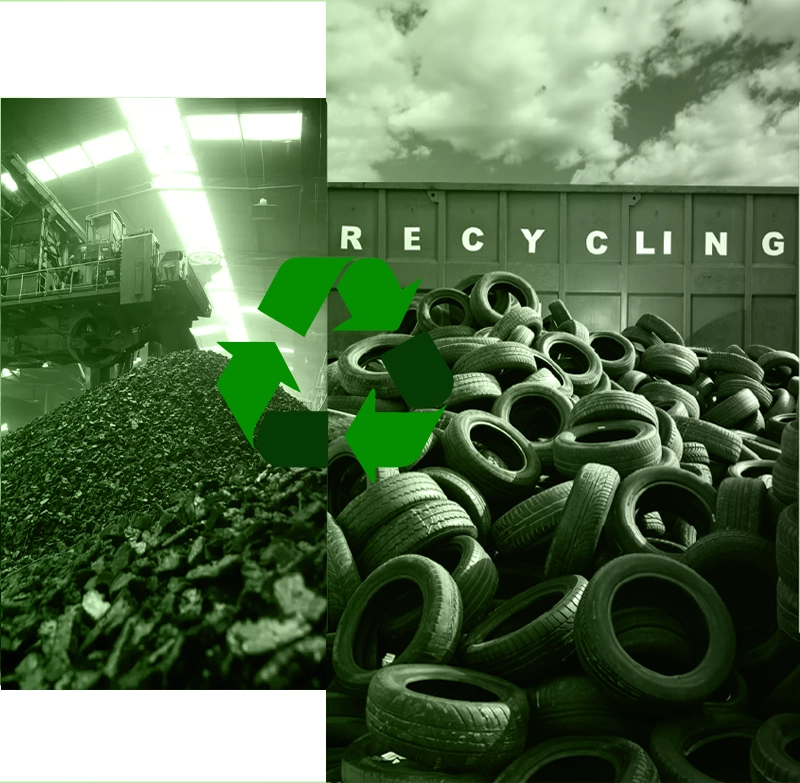
The moment a tire becomes scrap
A tire stops being a tire the day it comes off your car for good. At that point Florida calls it a scrap tire, and the rules change. It’s no longer something you can throw in the trash or stack behind the shop. It’s regulated waste, and it has to go to a permitted facility — somewhere like us.
When you drop tires at our counter on West Main Street, the first thing we do is the boring-but-important part: count them and check them. If they came in on the wheel, we pull the rim. Steel and aluminum can’t ride along into the rubber stream, so the wheel comes out before anything else happens.
Sorting, then shredding
Not every scrap tire goes the same direction, so they get sorted first. A tire with a solid body might be worth more as a retread than as fuel. The rest head for the shredder.
Shredding is exactly what it sounds like. Big rotating blades chew whole tires into chips, then into smaller and smaller pieces depending on what’s being made. Along the way, magnets pull out the steel belts and bead wire that live inside every tire, and that metal gets sold off as scrap. Nothing about a tire is one material, and the recycling has to respect that.
🛞
Scrap tireoff your vehicle→
⚙️
Sort & shredcleaned, cut down→
🔥
Tire-derived fuelkilns & mills · replaces coal♻️
Crumb rubberplaygrounds · turf · asphaltTire-derived fuel
A big share of what gets shredded becomes tire-derived fuel, or TDF. These are chips burned as a fuel in cement kilns and paper mills in place of coal. Tires burn hot and steady — there’s a reason a tire fire is so hard to put out — and that energy gets put to work instead of wasted.
It’s not glamorous, but it’s honest recycling. A tire that would’ve sat in a pile for fifty years instead replaces coal that would’ve been dug up and burned anyway.
Crumb rubber — playgrounds, turf, asphalt
The other big road is crumb rubber. Tires get ground down past chips into small rubber granules, the steel screened and magnetted out, until what’s left is clean rubber by the ton.
You’ve stood on it without knowing. Crumb rubber goes under playground equipment so a kid bounces instead of breaks something. It’s the springy infill in athletic turf and the cushion in running tracks. Mixed into rubberized asphalt, it goes into roads that take heat and cracking better than plain pavement — which, in Florida, matters.
Casings and civil-engineering uses
Some tires never get shredded at all. A sound casing — the body of the tire left once the tread is worn — can be retreaded, where fresh tread is bonded onto a carcass that’s still strong. That’s common on trucks and fleets, and it’s the cheapest kind of recycling there is, because the tire just keeps being a tire.
Whole tires also show up in civil-engineering work: lightweight fill for embankments, drainage layers, erosion control. Not every tire fits that use, but it keeps another batch out of the ground.
Why none of it goes into a Florida landfill
This is the part a lot of people don’t realize. Whole waste tires are banned from Florida landfills — they have been for years. They don’t compact, they float back up to the surface, and a buried pile is a fire and mosquito problem waiting to happen. So the law (Florida Statute 403.717) routes them to permitted facilities and registered haulers instead. The Florida DEP oversees the whole chain.
It works better than you’d guess. The U.S. Tire Manufacturers Association (USTMA) reports that about three-quarters — roughly 76% — of U.S. scrap tires now go to end-use markets like fuel, crumb rubber, and civil engineering rather than dumps. The $3 you spend dropping a tire with us is what keeps it inside that 76% instead of in a ditch off Rock Springs Road.
Common questions
Where do my old tires actually end up?
Most get shredded. The shreds become tire-derived fuel for cement kilns and paper mills, or crumb rubber for playgrounds, turf, tracks, and asphalt. A good casing might get retreaded. None of it goes into a landfill whole.
Is the rubber really reused, or is that just marketing?
It’s real. USTMA puts about three-quarters of U.S. scrap tires into end-use markets. If you’ve been on a playground surface or a running track lately, odds are you were standing on a recycled tire.
Can a tire be recycled with the rim still on it?
Yes — the wheel just has to come off first, since metal can’t go into the rubber. We take tires rims on or off and pull the wheel here, so it’s not your problem.
What happens to the steel inside a tire?
Every tire has steel belts and bead wire in it. When it’s shredded, magnets pull that steel out and it’s sold as scrap metal. Even the metal gets a second life.